
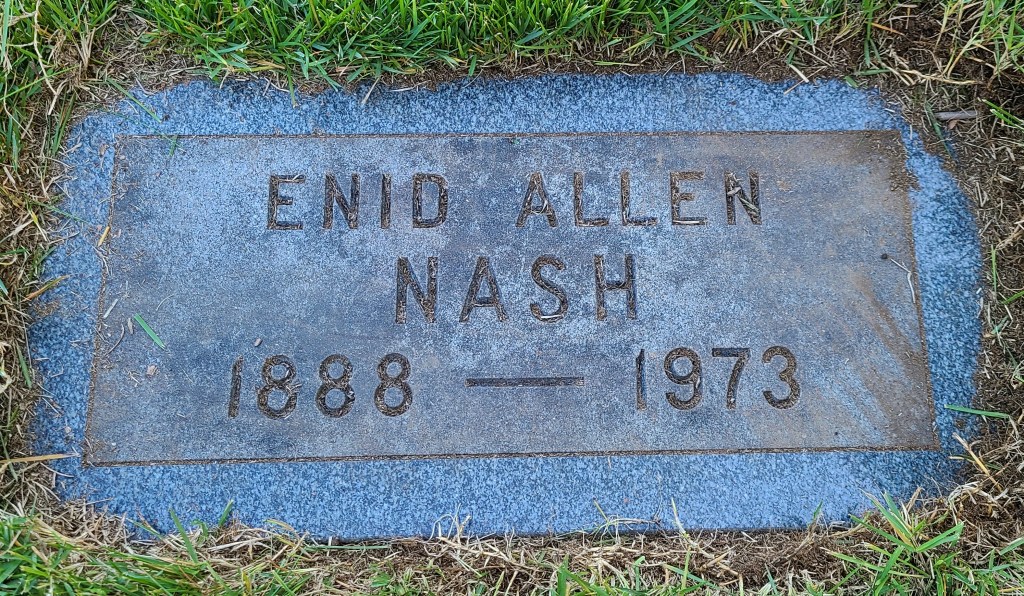
DOB/DOD: December 5, 1888 (Brooklyn, NY) – July 25, 1973 (Stamford, CT); 84 years old
LOCAL ADDRESS: Hilltop Road (1940 census)
MARITAL STATUS: Married Douglas E. Nash (1890-1972) on March 29, 1921, in Racine, Wisconsin.
CHILDREN: Two sons, Benjamin C. (1922-1978) and Richard E. (1924-1976). One daughter, Enid L. Nash Gould (1927-2005).
FAMILY: Born to William H. (U.S. Navy veteran) [1847-1889] and Julia Belle Capwell Allen [1854-1892]. One brother, Albert C. [1880-1945]. Her parents died when she was a child. She was raised by an uncle and aunt, Reverend Charles A. Capwell and Irene Capwell, of Racine, Wisconsin.
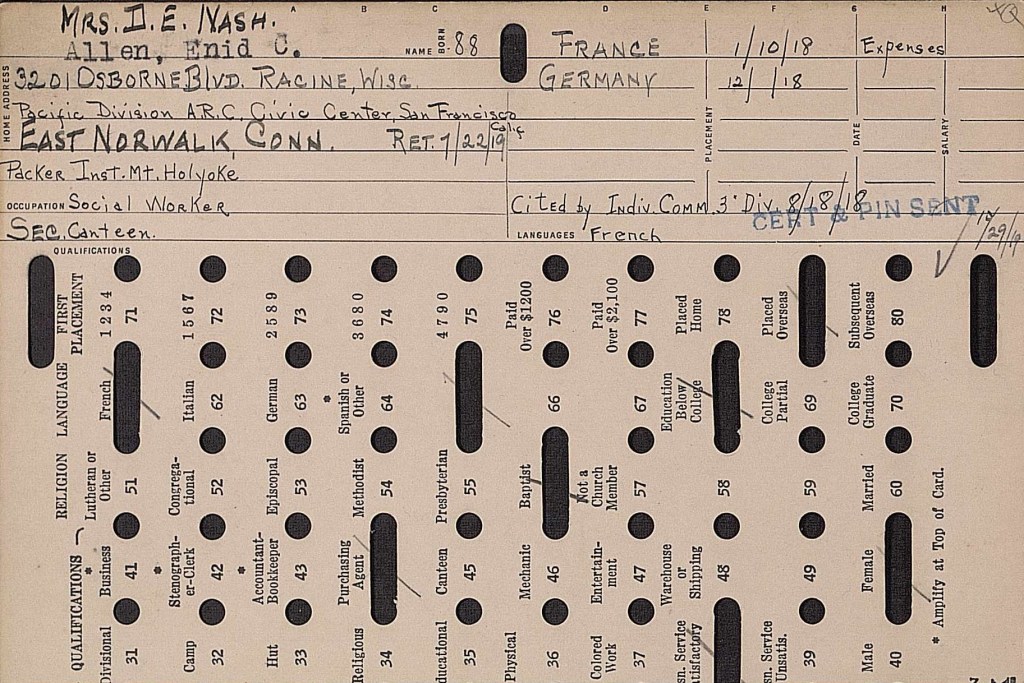
SERVICE: Enid Allen worked as a Social Worker for the YMCA. She was fluent in French and was assigned to France on January 10, 1918. She was then assigned to Germany in December 1918. She retired on July 22, 1919. Her card said she was cited, likely for bravery, by the 3rd Division.
OTHER: Enid’s father-in-law, Lewis Nash, founded Nash Engineering in Norwalk. The Nash Engineering Company was formed in Brooklyn, New York, by Lewis H. Nash in 1905. A native of Norwalk, Connecticut, Nash moved the firm to his hometown in 1908, where it manufactured air pumps in a small shop on Water Street in South Norwalk. In 1910, Nash patented his first designs for several vacuum pumps and compressors used in steam heating and sewage systems, and the following year, a new facility was established on Wilson Avenue in South Norwalk.
Mount Holyoke College, Class of 1914

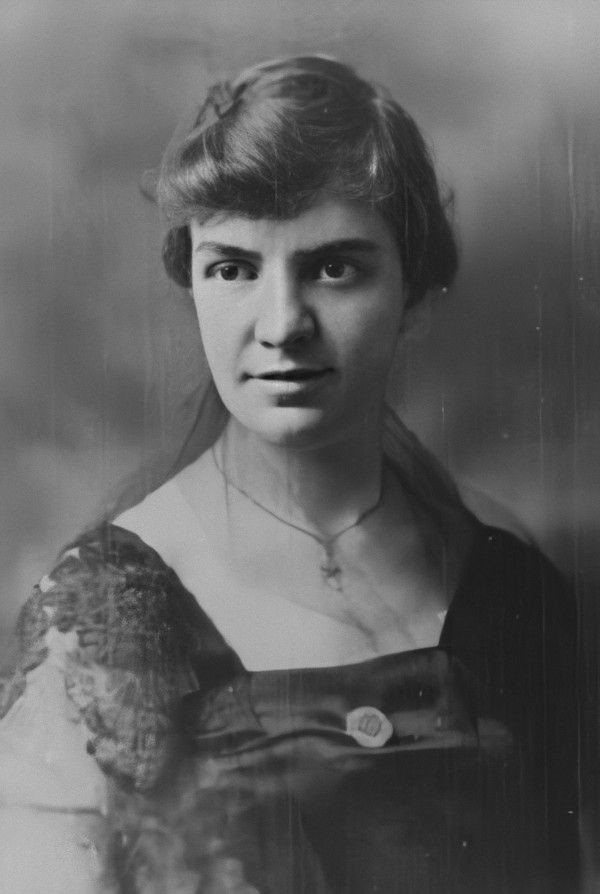
Passport photo included with her husband’s passport application in 1921
From The Kalamazoo Gazette July 5, 1918
MISS ENID CAPWELL ALLEN CANTEENIARE IN FRANCE WRITES OF HER WORK
URGES EVERY MAN TO HELP BEAT HUN
WEBMASTER NOTE: A canteeniare is a person who works at a military post or camp, a general store at a military post, or an establishment that serves as an informal social club for soldiers.
Miss Enid Capwell Allen, a cousin of Mrs. Charles H. Ring, 517 Minor Avenue, and niece of Reverend C.A. Capwell, of the Church of Holy Innocents’, Racine, Wisconsin, is a canteenaire under the Y.M.C.A. in France. Miss Allen has been close to the fighting front. She makes an appeal to American manhood in a most interesting letter just received by Mrs. Ring. She declares that no strong, able-bodied young man ought to be out of uniform. Also, she tells something of the experience of a canteen worker. Extracts from the letter follow:
“Somewhere in France,”
June 12, 1918.
“Dear All: —
“These last days have been indeed cold. In my last letter, I believe I told you that we were preparing to follow Mr. Danforth. Y.M.C.A. canteen organizer nearer to the front. Throughout this letter, please remember that no real chances are being taken and that we are not, alas, allowed by the army to go where there is danger.
“We started — 15 of us — nine men and six girls, on a truck, we on top of the baggage, at 5 A.M. to catch a 6 o’clock train about 15 miles distant. We reached the train in plenty of time, only to find that there was quite a lot of red tape that the provost-marshal had to go through and that there was not time enough to get all our papers arranged. So we had, all of us, to wait until 3 P.M. A truck was supposed to meet us at the end of our journey to take us 30 miles, but nothing met us at 5 o’clock when we finally arrived. After about three hours of telephoning, we got a message through to tell Mr. Danforth that we had arrived. A French Major had to do this, and I acted as interpreter. We had finally located food – which is very difficult nowadays – and at 8 p.m. Mr. Stewart went to corral the crowd. I was standing In the middle of the street trying to arrange with a Frenchman for rooms. when two American boys came up and asked me if I could talk “United States.” They then asked if I would help them get food. When I told them our fix, with no place to spend the night, they asked if they could help. I couldn’t see just how two lone boys could aid us until they said they had two trucks at their service and would take us. Believe me, we hailed them. We ate, and at about 9 p.m., we got started. I had a map and, as an interpreter, sat in the front of the first truck. The baggage was piled, half in one truck and half in the other, and the men and girls on top, except for two girls on each front seat. “Every time we came to a crossroad, I had to hop off and look at a signpost. We got on pretty well, except once a French machine with officers in it came very nearly into collision – none of us could carry lights – and another time, we barely escaped another truck. There was another one close behind it, and when the first one stopped, the second went into it. We heard the crash but couldn’t stop to see. As we went north, we could see cannon flashes in the sky. When we finally arrived, sleepy and covered with dust, it was 1:30 a.m. We had no sooner untangled ourselves than we were greeted with the news that at 3 a.m., they expected a gas attack.
“Mr. Danforth insisted that we get into the trucks and go to a town farther back where he would meet us. So we piled in again. This time, we lost the road trying to get around a French cavalry train, and we arrived at 5 a.m. Could you have seen us then! We camped out on curbstones as nothing was open, and we couldn’t find a solitary room. Finally, some soldiers let us have their bunks, and at 8 a.m., we slept for two hours. Meanwhile, the boys with the trucks went on to Paris with one of the girls, who was a bit scared. About 11 a.m. Mr. Danforth came, shipped off to Paris all but one of the men, and found us a place to stay in—a “young ladies” boarding school. The boarding pupils had gone and we had the big dormitories to ourselves. Mr. Danforth left us for a day. The next day, he sent for his secretary and two of the others of us. We drew lots, and I was one to go.
“I am back again now, writing in the dormitory because one of the girls went into Paris, and I am staying with the others. The plan will probably be for two or perhaps three of us to stay back here, open a Y. M. and do hospital work, the others to be up with Mr. Danforth, taking turns week and week about. Up there, we heard the cannon off and on all night and could hear
cavalry and artillery pass by all night; truck Ioads of men,” too, changing their position on the front. We saw aeroplanes to our hearts’ content and could tell that they were trained flyers by the stunts they did. One day, we saw three groups of 12 to 15 aeroplanes in the sky at once.
We have seen them drop messages, too, attached with streamers that they might be seen. Tonight, they say there are to be many German prisoners brought in, and alas, I shall not be there to see them. Still, I may get a trophy just the same.
“Our men are doing wonders. One of the lieutenants in my own company has won the Croix de Guerre [WEBMASTER NOTE: The Croix de Guerre is a military decoration of France. It was first created in 1915. The decoration was first awarded during World War I, again in World War II, and in other conflicts. The Croix de Guerre was also commonly bestowed on foreign military forces allied to France. It may be awarded either as an individual award or as a unit award to those soldiers who distinguish themselves by acts of heroism involving combat with the enemy. The medal is awarded to those who have done heroic deeds], the first in the whole division, the first day on the front! If you find a paper about June 8, with a paragraph about Lieutenant Flannery, who swam the Marne River with a rope and towed back, with the rope in his teeth, a wounded Frenchman, I wish you’d send it to me. I haven’t seen any in my company or my regiment because they were too far up. One could only go by night, and Mr. Danforth wouldn’t take me. I’ve seen the Marne, however, and the banks on the other side where the Germans are. All these towns have been evacuated (not the one I am in now, or the one we made headquarters. People did go from the latter but are returning). I’ve seen so many refugees with all their goods in baby carriages and the children tagging on behind. Where they own livestock that pulled all sorts of old conveyances. This morning, we saw three heavy ricks piled high with feather beds, tables, chairs etc., etc. A cow pulled one, the children walked behind carrying things, and at the last of the train was an old, old woman driving a most dilapidated Victoria [WEBMASTER NOTE: a light four-wheeled horse-drawn carriage with a collapsible hood, seats for two passengers, and an elevated driver’s seat in front], empty save herself.
“We are not through this war by a long shot, but we are going to win, and the United States boys are made of the right stuff! It is open warfare now, and if we can only get the Germans on the run, and we will! Open warfare is our lone suit and it is where we are shining this minute.
“I’m stronger for the stars and stripes every day and prouder and prouder. Only, we need men and men, millions. Had we men we could go in now and surprise the Germans quite some. No abled-bodied, physically strong young man ought to be out of uniform! I don’t understand how these can. The future of the world depends on them. It may mean temporary discomfort for the mothers and children or even permanent privation and sorrow, but it would shorten the war, lessen the number of casualties, and put away forever the danger of the yoke of the Huns. And the only way we can win is by fighting, they cannot ever be starved into submission.
“I have not told you what we do at the front. We take Ford camionettes [WEBMASTER NOTE: a small truck or bus. The word comes from the French words camion, which means cart or wagon, and -ette] with cigarettes, chocolate, jam, and canned fruits, and go where the boys are camouflaged in the woods, etc., and sell them stuff. They just have to stay hidden in the day time and move around at night. Lots of times, the kitchens haven’t reached them, and they haven’t had anything to eat for hours, and our chocolate is welcome—to say nothing of the jam and fruits. Besides, they seem to enjoy seeing an American girl again. There are not many, especially on this unstable open front. Up with Mr. Danforth, we have to have our gas masks always at hand, and in certain places, we wear our helmets. This is only as a precaution and orders.”
From The Norwalk Hour July 27, 1973
Mrs. Enid Allen Nash of Salt Marsh, Noroton, widow of Douglas E. Nash, retired President of the Nash Engineering Company, died Wednesday at Nursing Gardens Home, Stamford, where she had resided for the past year. She was 84 years old. Mrs. Nash was a native of Brooklyn, New York, the daughter of William and Belle Allen. She graduated from Mount Holyoke College, Class of 1915, and had been an active alumnae member since graduation. She was married to Mr. Nash on March 29, 1921, and took up residence in Norwalk, where the Nashes lived most of their active life. Mrs. Nash was active in many local organizations in the Norwalk area. She was active in the Norwalk Day Nursery Board for years, was a member of the Women’s Board of Norwalk Hospital, Chairman of Norwalk Chapter, American Red Cross, in World War II. She was active in the National Red Cross during that time. Mrs. Nash is survived by two sons, Benjamin C. Nash of Noroton, president of tho Nash Engineering Co. and Richard E. Nash of Rowayton; a daughter, Mrs. Enid Louise Gould of Sudbury, Massachusetts and nine grandchiidren and one great grandchild. Memorial services will be held at the Noroton Presbyterian Church at 2 P.M. Monday. There will be no calling hours. In lieu of flowers, donations to the Mount Holyoke Alumnac Fund, Norwalk Hospital Development Fund, or the Norwalk-Wilton Chapter American Red Cross will be appreciated by the family.
Enid Nash is buried in Spring Grove Cemetery, 41 Hecker Avenue, Darien, Connecticut; Section P, Grave 8, overlooking the pond.
END
Discover more from Honor Norwalk CT veterans
Subscribe to get the latest posts sent to your email.
 Honor Norwalk CT veterans
Both my grandfathers worked for Nash engineering. I was at one time the musical director for the Nash engineering fife and drum Corps that performed in many parades in the 60”s and 70’s. The Drum Corps had many Veterans in it when I joined in 1961, and the uniforms were copies of the West Point cadet’s uniforms but different in colors and having same tunic with cross belts and heart and bullet deflector at the crossing of the straps at the center chest area. I met several of the Nash Family on several occasions through years. The drum corps was one of the best in its class at the time.
Charlie
LikeLiked by 1 person
That letter from her service during the War is an amazing testament of her service. Thanks for sharing.
LikeLike
Thank you very much for the feedback and for your interest. My hope is that the Women of World War I are never forgotten.
LikeLiked by 1 person